
What Is Extensive Grammaring?
Extensive Grammaring is about practicing: taking vocabulary and turning it into sentences. The key is a rich context, such as a story that makes the grammar meaningful.
It came from a simple observation: even after studying grammar in class, students still kept making mistakes. Many of these could be described as “broken English” where the student was speaking using vocabulary, without the grammatical words needed to make it a natural sentence.
The solution: give them practice at turning broken English into natural sentences.
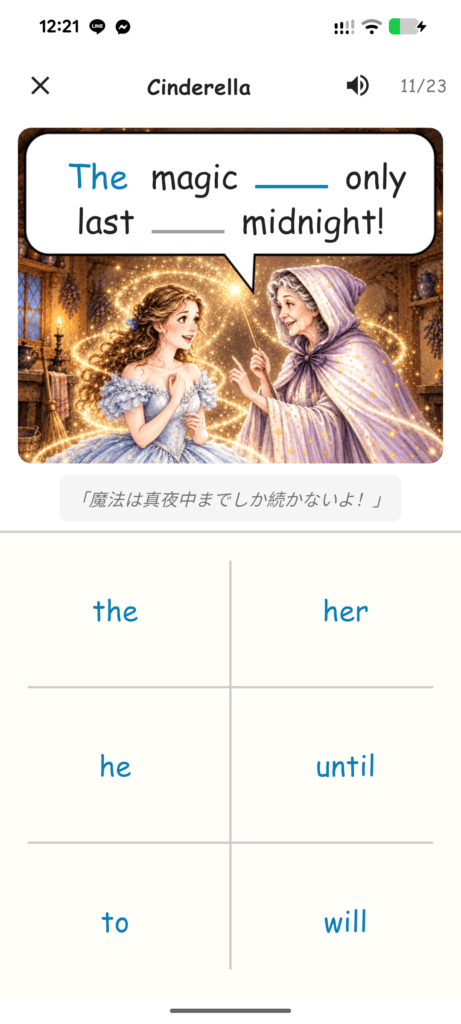
An screenshot from the app You Know It. The learner practices grammar by quickly filling in the grammar gaps until the grammar becomes intuitive.
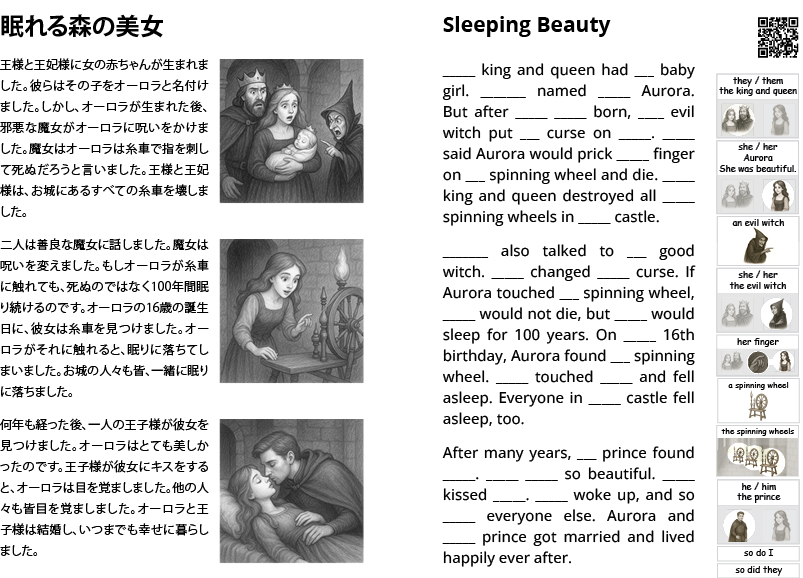
Pages from the book 物語で英文法の練習 (Monogatari de Eibunpou no Renshu). Students understand the story by reading the Japanese, then practice putting in the English grammatical words, many of which don’t have Japanese equivalents.
What Is Grammaring?
Dianne Larsen-Freeman coined the term “grammaring” to refer to grammar as a skill to be honed, not knowledge to be learned. Like any skill, it is developed through practice. This was in response to the inert knowledge problem: students acquire knowledge in class, but not the skills to use it.
Why Extensive?
The second idea comes from Extensive Reading: read a lot in the target language, and the more exposure you get, the better you get at the language in general. It often uses stories.
Extensive Grammaring is similar in the way that it involves practicing using lots of stories, but it is more focused on developing skills to produce natural, grammatical sentences. The more sentences you produce, and the faster you do it, the better you get at making sentences. Through practice, the words simply come, much like they do when we speak our first languages.
My Experience With Extensive Reading and Extensive Grammaring
I’ve tried extensive reading in Japanese many times. I love the idea of it.
But in reality, I sit down, maybe read a page or two, then put the book down. I’ve tried easier books and ones at my level, but the same thing always happens.
I think it’s because of goals. The theory behind extensive reading is that reading should be enjoyable. But no matter what, it’s not. If it’s too easy, I don’t feel absorbed by the story, like I would in English. It lacks depth. Higher level content takes more effort for me to process. I simply feel that if I wanted to enjoy a story or learn something through reading, it’s much easier to do it in English.
Every time I’ve tried extensive reading it seems like a chore. My goal is to read it and enjoy it, all the time being aware that the content would be so much easier and more enjoyable to read if it was in my first language.
From Chore to Puzzle
I had taught English for over 15 years and during this time, I developed grammar practice materials that I used in the classroom, designed to help learners use grammar in context. I took the basic idea of the worksheets and turned them into an app activity.
I was thinking about testing this with students, but I came to the realisation that to really know, I needed to try it for myself. So instead, I developed Japanese and Spanish versions. I am quite fluent in Japanese and an absolute beginner in Spanish.
I surprised myself.
The man who couldn’t get past five minutes of a story in Japanese found himself absorbed in the content an hour later. I had to consciously make effort to put the app down!
Then the same thing happened in Spanish!
I had a different goal. I wasn’t trying to understand the stories. They were traditional stories that I already knew.
My goal was to find the grammar I needed to tell the story.
And I think this is a more satisfying goal because it is essentially the same goal I have when speaking: to find all the words I need to express myself, in sentences, with correct, natural, meaningful grammar.
The activity brings the grammar into the spotlight. With the story and key vocabulary there on a plate, I can focus all my mental energy on the area I need to improve: the grammar.
But I Want to Understand More!
This practice was fun. But there were times when I found I was simply guessing and getting used to patterns without really knowing what it means. This was especially true when the grammatical words didn’t have direct translations in English.
I wanted help. I wanted someone to give me hints to guide my thinking, to explain where I was going wrong, and to help me understand the meaning behind the grammar that simply didn’t translate.
I thought about building tips and hints into the app, but the more I thought about it, the more I thought that this is more effective in a dialogue format where I direct answers to my questions.
Self-Study Is Great, but I Needed a Teacher.
The content in the app actually started as a book which I almost abandoned as I thought the app had far too many advantages over a paper format. But after using the app, I changed my mind. Paper has some things the app doesn’t.
- Tapping buttons is good for speed, but writing with a pen and pencil makes it stick.
- The paper format was ideal for asking for help and feedback.
I took the Spanish content I had in the app and created a paper sample. I attempted it: some answers I was very confident with, some were a bit of a guess, and for some I had no idea and left them blank.
I was left with a sheet that exposed gaps in my knowledge. Now I just needed a teacher to help me understand.
But I didn’t have one. So, I asked a general-purpose AI chatbot.
And it did a pretty good job. I took a photo of my work. It checked it, told me what was wrong, gave me translations of vocabulary, helped me understand phrases I needed but didn’t know, and gave me hints to help me fill the gaps.
I would have preferred to talk with a teacher, but as self-study, I found this very effective.
Just like in a classroom, materials help teachers deliver better lessons, and teachers make materials easier for students to understand.
So, from now on, I’ll use both paper and the app.
Paper to consolidate my understanding.
The app for practice to improve speed and fluency.
The Right Kind of Practice
The more I think about it, the more confidence I have that this practice is aligned with my language learning goals. I’m not just learning about the language, but developing skills.
I’ve always thought that grammar that allows you to communicate freely is not acquired through rules. Children learn to speak in grammatical sentences long before they know what a grammar rule is. Many adults who are highly effective communicators don’t know “the rules”. That said, some instruction in grammar may be useful for learners to gain confidence that they know about the grammar, but ultimately practicing is what will help them develop communication skill.
So, both first-language and second-language learners need the same ingredients: lots of exposure to the language. Lots of practice doing it. But we can make the practice more focussed by lightening the load, with a meaningful story the learner already knows and giving them the key vocabulary to tell it, leaving them to provide the grammar required to connect ideas and make the story flow.
But knowledge of grammar is not enough. To be truly effective communicators, we need to master it to a level where we can employ it with a high level of accuracy at rapid pace.
As a learner who can confidently communicate in Japanese, it has helped me see some common slips I was making. and become more familiar with grammatical patterns, and move beyond the basic grammatical constructions I was relying on.
As an absolute beginner in Spanish, it gave me exposure to simple grammatical forms and helped me see patterns and understand usage. It also helped me gain confidence and develop a sense of the structure of the language.
At this point, Extensive Grammaring is still new and I’d love teachers and learners to give it a try. I hope you find it as satisfying and engaging as I do, and feel a sense of fulfilment as you are practicing the very skill of taking words and putting them into sentences to express something. The skill that so many language learners find challenging. So far, it looks like it can offer something for everyone.